
Free DMV Practice Tests for District of Columbia
Results
Good job! This is a passing score. Do you want to try another test?
Unfortunately, this is not a passing score. Do you want to try another test?


#1. If your car starts to skid, you should do all the following except:
You should not brake hard.
Take your foot off the gas pedal. Steer in the direction of the skid. If your rear wheels start going to the right, turn your front wheels to the right. Once your car regains traction, straighten out your wheels.
This question asked what you should not do.

#2. You are driving on a road with few streetlights on a clear night. If you cannot see well with your low-beam headlights, which of these actions would help?
Use high beams in open country when there are no oncoming vehicles.
Dim your lights when necessary.

#3. A blind spot is the area of the road:
Blind spots are areas which cannot be seen when using your mirrors. Check your blind spots by glancing over your shoulder in the direction you want to move. Never cruise in the blind spot of the vehicle ahead of you.
Always remain alert and check your blind spot frequently.

#4. Always turn your front wheels toward the curb when you are parked on a grade and facing:
Headed downhill, turn your front wheels into the curb or toward the side of the road. Set the parking brake.

#5. What is the meaning of this sign?
Traffic signal ahead.
Slow down and be ready to stop at the signal ahead.

#6. You must always stop before railroad tracks if:
Do not get trapped on a railroad crossing. Never drive onto a railroad crossing until you are sure you can clear all the tracks safely.

#7. Unless otherwise posted, the speed limit in an alley is:
The speed limit in any alley is 15 mph.

#8. How long will points stay active on your driving record?
Points will stay active on your driving record for two years. Points are automatically removed from your record after two years.

#9. When your car has an enabled front passenger airbag, a rear-facing infant seat must:
Infants should never ride in the front seat of a vehicle with a passenger-side airbag. Remember, all children 12 and under should ride in a rear seat.

#10. In this situation (approaching the bicyclist from behind), you should:
If possible, you should avoid passing other vehicles, including motorcycles and bicycles, on two-lane roads.
Remember, if you are unable to safely pass, reduce your speed, follow the bicycle, and wait for a safe opportunity to pass. In this situation passing on the other half of the roadway is not allowed.
Avoid the use of your horn.

#11. Orange road signs are used for:
Orange is used for construction and maintenance work area warning. Most signs used in highway and street work areas are orange and diamond shaped.

#12. What does this sign mean?
Divided highway ends. The road ahead has two-way traffic.

#13. The following are true about large trucks except:
It is not true that trucks need shorter stopping distance.
In general, large trucks have longer stopping and accelerating distances. A truck traveling at 60 mph takes more than 400 feet to stop.

#14. If you strike an unattended vehicle and cannot find the owner, you must:
If an unattended vehicle or other property is damaged, an attempt must be made to locate the owner. If the owner cannot be located, a written notice giving the identifying information must be left in or on the damaged vehicle or property in a conspicuous and secure place.

#15. Driving a vehicle equipped with anti-lock brakes allows you to:
Anti-Lock Braking Systems (ABS) are designed to prevent your wheels from locking up when braking. This will prevent skidding and allow you to steer during an emergency braking situation.

#16. If you run off the pavement, you should:
If you run off the road, do not panic. Take your foot off the accelerator. Brake carefully or not at all. Grip the steering wheel tightly. Do not try to get back on the roadway until you have the vehicle completely under control. Speed should be 15 mph or less. Look for traffic behind you and beside you. Then turn the wheels sharply toward the roadway.
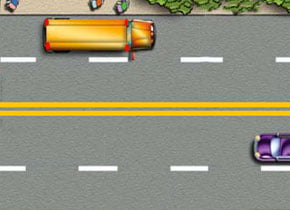
#17. You meet a school bus that has stopped on the other side of a highway with no median separation. If the bus has turned on flashing red lights, you must:
Unless the bus is on another roadway, you must stop. Remember, if you approach a school bus from either direction and the bus is displaying alternately flashing red lights, you must stop.
#18. Which of the following is the most common kind of motor vehicle accident?
Rear-end collisions are the most common kind of motor vehicle accidents.

#19. From which lane should you turn right on a four-lane highway?
The correct lane for the right turn is the lane furthermost to the right, unless posted otherwise.

#20. This sign means:
Cross road. Another road crosses the highway ahead. Be alert for cross traffic and regulatory signs or signals.

#21. The Do Not Enter sign is an example of a regulatory sign, and it is:
Do not enter.
The sign marks a one-way roadway with traffic coming against you. You must not enter from the direction you are traveling.
Remember, this is a square sign with a white horizontal line inside a red ball. The sign is not circular, which you may be led to believe by some illustrations in the DC driving manual.

#22. When two vehicles from different directions arrive simultaneously at an intersection with no signs or signals, which should have the right-of-way?
When two cars enter an open intersection (without traffic control signs or signals) at the same time, the driver on the left must yield to the driver on the right.

#23. Why is it wise to slow down a little at night?
It is wise to slow down a little at night.
At night, you do not see as far, as soon, or as much and everything has a different appearance. Keep your speed low enough to be able to stop within the distance you can see ahead.

#24. The road edge on the right side is marked by a:
Solid lines along the side of the road show you where the edge of the road is located.

#25. When you proceed straight ahead on a solid green light, you must:
A steady green traffic light means go. Proceed with caution after you have checked first to see that other vehicles have cleared the intersection. Do not enter the intersection if you will block traffic.
When it is safe to proceed, you may enter the intersection to go straight ahead or turn unless a sign or additional signal prohibits the turn. You must yield to pedestrians and vehicles already in the intersection.
District of Columbia DMV Knowledge Test – Quick Facts
| What You Should Know | |
|---|---|
| Number of questions on exam: | 25 (non-GRAD) 30 (GRAD) |
| Passing score: | 80 percent |
| Correct answers to pass: | 20 (non-GRAD) 24 (GRAD) |
| Allotted time to complete test: | 60 min. (non-GRAD) 75 min. (GRAD) |
| Wait time before retest: | 3 days |
| This Practice Test | |
|---|---|
| Number of questions on each practice test: | 25 |
| Question pool: | 500+ |
| Each test is random | |
District of Columbia DMV Sample and Practice Tests
This 25-question sample test addresses the non-grad knowledge test, which includes all questions about road signs, traffic signals, D.C. traffic rules, safe driving, and common courtesy on the road.
The official 30-question GRAD test contains additional questions about the graduated licensing program. If you are under 21 and must complete the graduated licensing steps, you must also pass the 30-question test. You can find an example of this test at Licenseroute.com – DMV Practice Test for Permit or check your knowledge of the D.C. graduated licensing program here
Each Sample Test is Random
Each driver’s license and learner’s permit test at driver’s prep has 25 random questions drawn from a larger pool of questions. Every test is different, and you will likely see new questions when you restart the test.
After each question, you will get instant feedback. If your answer is incorrect, there is also a brief comment that explains the correct answer. Remember that you can find all answers on the official examination in the D.C. Driver’s Manual.
The passing score in the District of Columbia is 80 percent, meaning you must correctly answer at least 20 of these 25 DMV questions. Aim a little higher when you are studying and preparing for the exam. You have a better chance of passing the examination if you score 100%.
You Should Always Read the D.C. Driver’s Manual
Studying the D.C. Driver’s Manual is a must for successfully passing the driver knowledge test.
You can get a PDF-version of the manual online from dmv.dc.gov or from your local Service office .
Always start by reading the manual. Then, use these practice tests to check how much you have learned and whether you are ready for the exam.
Don’t use the practice tests instead of the manual, even if friends and some less committed websites suggest such a strategy. The best way to learn is to put the rules of the road in context and not simply try to memorize questions and answers.
Learn more about How to Study for the driver test.

Who Must Pass the District of Columbia Driver’s License Test?
If you never had a license before, you must always pass the written knowledge test.
In District of Columbia, foreign Nationals with a valid out-of-country or out-of-state driver’s license must also pass the knowledge examination.
If you have a D.C. driver’s license and let it expire for more than 365 days, you must take and pass the knowledge test or take the District’s online traffic school course to waive the knowledge test. If your D.C. driver’s license has expired for more than 545 days, you must take and pass both the knowledge test and the road skills test.
When DMV has revoked your driver’s license and you want it back, you must apply for a new license and take all necessary tests again.
Things to Know about the Knowledge Examination
The driver examination checks your knowledge of traffic laws, road signs, and driving safety rules. The knowledge test will show if you can drive a vehicle following D.C. law.
The knowledge test consists of several highway signs. The DMV examiner will also check if you pay attention to the signs during the driving test. You should learn all common highway signs and know how to act when you see one.

Languages
You can take the driver’s license knowledge examination at any DMV service center. There is no need for an appointment. DMV offers all testing on a walk-in basis. Tests are available in the following languages: Amharic, Arabic, Cantonese, English, French, German, Japanese, Korean, Mandarin, Portuguese, Russian, Spanish, Tagalog, Thai, and Vietnamese.
You can get an audio-assisted test if you need help with reading. Ask for a headset before you take the exam.
If you fail the official knowledge test, you must wait at least 72 hours (3 days) before retaking it on the 4th day.
Should you fail your knowledge test six (6) consecutive times, you must wait one year from the date you failed the first test.
You must pay a new testing fee each time you take the knowledge test. Trying to pass it the first time by preparing well is a good idea.
How many questions are on the District of Columbia DMV exam?
If you are under 21 years and follow the graduated licensing steps, the official knowledge test has 30 questions. If you are 21 years or older, the test has 25 questions.
What is the passing score on the District of Columbia DMV exam?
The passing score is 80%. On the GRAD test with 30 questions, you must correctly answer 24 questions. On the 25-question test for applicants over 21 years, you must correctly answer 20 questions.
What is the waiting time if I fail the D.C. DMV knowledge exam?
You must wait at least 3 days and can retake the test on the 4th day.
Remember
Walk-in service is available at all Service Centers and Adjudication Services.
Road tests for commercial and noncommercial driver’s licenses are by appointment only.


I need to test on line
DC DMV does not offer the official test online from your home. You must take your knowledge test at a Service Center or Test Proctoring Center.